

How The Highest-Selling Jazz Solo Album Came To Be: 'Köln 75' Reviewed
Milo Farragher-Hanks reviews Ido Flukes' stylish biopic which charts how a determined 18-year-old booked pianist Keith Jarrett for what became a landmark jazz concert
At 11:30pm on the night of the 24th of January 1975, jazz pianist Keith Jarrett took to the stage of the Cologne Opera House. Over the next seventy-five minutes, he played an entirely improvised concert on a thin, tinny baby grand piano. A recording of the concert was released ten months later, becoming the highest-selling jazz solo album and piano album in history, and securing a place in music history as one of free jazz’s most fearless, innovative acts of improvisation. A new film, Köln 75, tells the story of how this epochal concert came together through the eyes of the woman who made it happen. It’s slick, propulsive and entertaining, informative for novices and indulgent in specifics for jazz obsessives. What the film leaves wanting, however, is a sense of the music’s own spirit of path-breaking discovery.
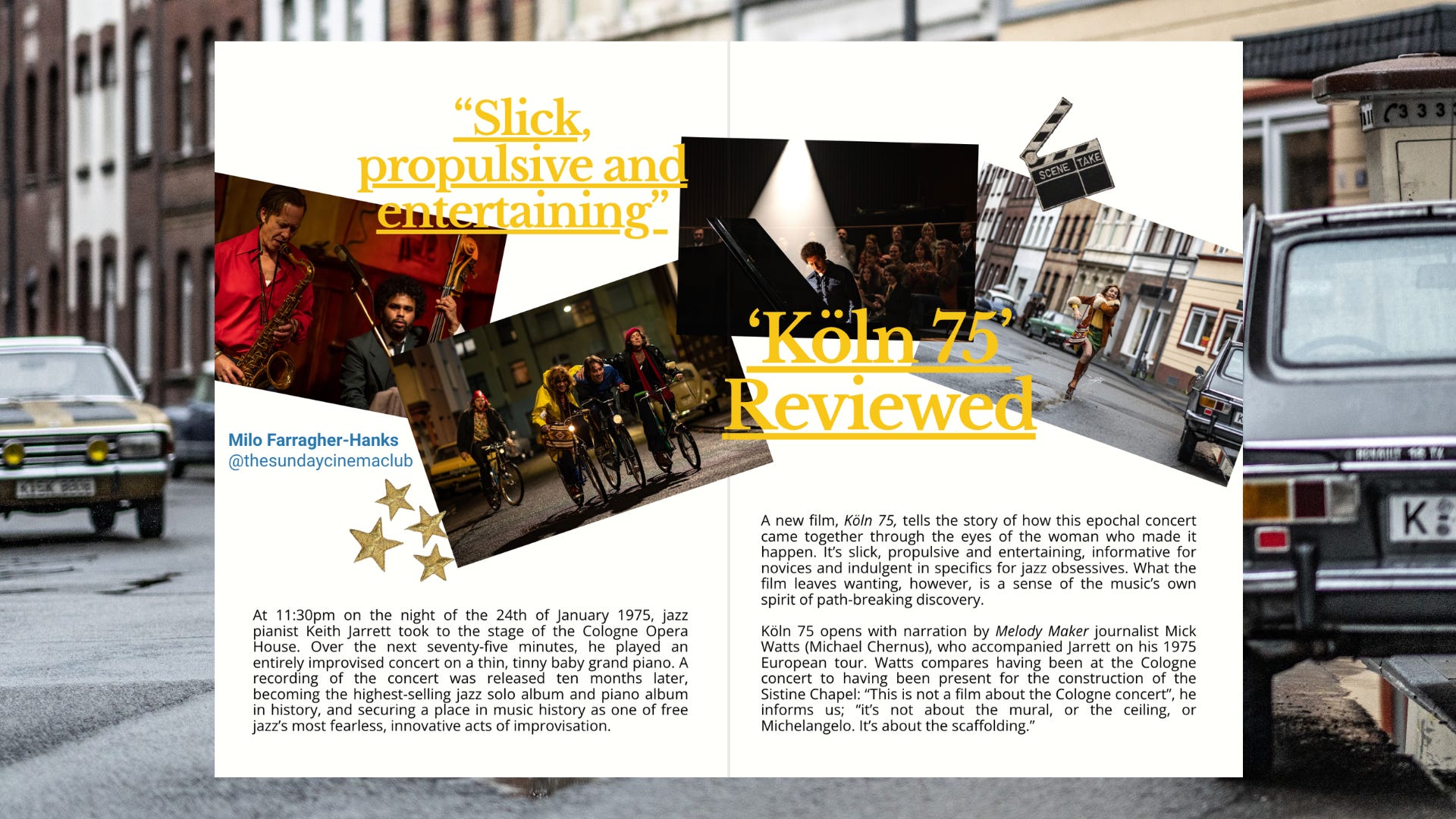
Köln 75 opens with narration by Melody Maker journalist Mick Watts (Michael Chernus), who accompanied Jarrett on his 1975 European tour. Watts compares having been at the Cologne concert to having been present for the construction of the Sistine Chapel: “This is not a film about the Cologne concert”, he informs us; “it’s not about the mural, or the ceiling, or Michelangelo. It’s about the scaffolding.” It’s perhaps an inexact analogy, but nonetheless surmises Köln 75’s writer and director - Ido Flukes’ - approach to the material, which is less about the creative brilliance of the concert itself than the strenuous behind-the-scenes manoeuvres which brought the event together against the odds. Chiefly, the efforts of promoter Vera Brandes (Mala Emde).
Vera is an eighteen-year-old jazz enthusiast with an extraordinary degree of confidence, yet has little direction in life when she attends a concert by British saxophonist Ronnie Scott (Daniel Betts). Instantly impressed by Vera’s self-possession, Scott asks her to book a German tour for him, and soon the teenager is attracting both the disapproval of her conservative parents and the bafflement of her peers by becoming, seemingly overnight, a jazz promoter. Meanwhile, Jarrett (John Magaro) is in something of a personal and career lull. Wracked by chronic back pain, he’s touring Europe in a beat-up car he’s also sleeping in, playing a series of improvised concerts, with his manager Gus (Corey Johnson) in tow and a bewildered Mick conducting interviews. After Vera attends one of these concerts in Berlin, she becomes determined to bring Jarrett to Cologne - a process which will end up involving all manner of challenges, from faulty pianos to testy opera house staff to one extremely erratic musical icon.
Flukes has put together a sleekly-manufactured and consistently engaging film. A palpable sense is created that the Cologne concert is an event which almost certainly should not have come together to happen, and Flukes weaves together the myriad mind-boggling details of the real story with a kinetic, goal-oriented momentum. The film has a strong feeling for the lower rungs of the music scene, the logistical nightmares of event planning, and - in the early sequences focussed on Jarrett - the steady mental and physical erosion of life on the road with little money and less energy.
The sequence where Vera first hears Jarrett play is a moment of genuine, haunting loveliness, enacted entirely in wide shots of Jarrett on stage and handheld close-ups on an awestruck Vera swaddled in the low-light of the auditorium. It’s a moment which speaks to something of what it feels like to encounter art which opens something in you, and makes a more potent case for Jarrett’s work than all the scenes of characters discussing his genius. Flukes also has a secret weapon in the shape of Emde. A decade older than the real Vera was at the time, she admittedly struggles to pass as a teenager, but nevertheless her palpably restless, careening physicality and wide, wild eyes give the film its centre of gravity. “I can’t picture anyone saying no to you” is what Scott tells Vera when she asks why he wants her to take charge of his tour, and Emde indeed puts across that sense of implacable drive.
What’s missing from Köln 75, however, is the very thing which made the Cologne concert the sort of event worth making a film about half-a-century on: a sense of the new and unpredictable. From Vera’s fight to prove herself to her arch-conservative father, to the skepticism of DJs who think of jazz as ‘museum music’, Flukes’ script sketches all of the film’s conflicts in an overused biopic short-hand. 70s German counter-culture is rendered through needle-drops, and shaky-cam drug trips; Magaro plays Jarrett through the approved troubled-genius signifiers of hunched physicality, an evasive gaze, and Brando-esque mumbling. Even the film’s efforts at shaggy irreverence feel rather shop-worn. Characters - chiefly Chernus’ Mick Watts - will intermittently break the fourth wall to fill in the audience on the real story or playfully comment on the film’s structure in the manner popularised by The Wolf of Wall Street and The Big Short around a decade ago, and pretty well run into the ground since.
There is, evidently, also a tension in the film’s attitude. On the one hand, the film seems to want to look back at the often male-dominated music scene with a retrospective feminist point-of-view. Yet its view of creativity is essentially macho, more that of an athlete than an aesthete. You might say the film comes down with a nasty case of Whiplash, reverently emphasising the actualisation of a creative vision out of blood-sweat-and-tears anguish over knottier questions of inspiration. That’s not a wholly invalid angle to take on a true story like this, of course, but when Jarrett finally takes the stage, one is left with the nagging sense that there might be more to be said about the Cologne concert in almost two hours than that it was difficult to put on. Coaxing a defiant Jarrett on-stage, Vera says she’s offering him the opportunity “to go somewhere new”; Köln 75 entertains, but it also emphasises how desperately the music biopic also needs to do just that.
Written by: Milo Farragher-Hanks
Want to contribute to ‘Sunday Cinema Club’? We are always looking for enthusiastic writers, editors and graphic designers to contribute to our work so please contact us with your pitches and ideas! We look forward to hearing from you and thank you for supporting independent film journalism!
Instagram: @thesundaycinemaclub